

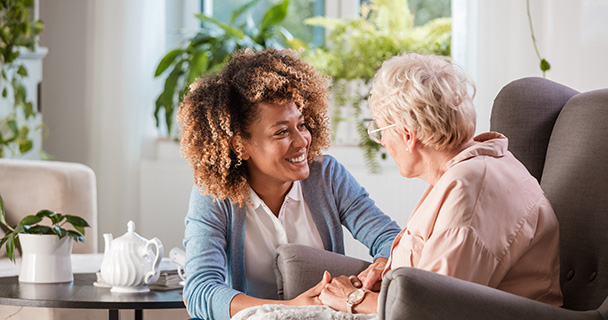
When an aging loved one needs support, many families automatically assume a nursing home is the answer. But here’s what we see every day at Brightwood: Most seniors don’t need a nursing home at all. They need something better—personalized, non-medical in-home care that lets them stay home, maintain independence, and preserve their dignity.
This guide breaks down the real differences so you can make the right choice for your family.
Understanding Your Options
There's an important distinction to understand first. Nursing homes are medical facilities—they provide 24/7 skilled nursing care for seniors with complex health conditions. Brightwood offers something different: non-medical in-home care services for seniors who need help with daily living, personal care, meal preparation, and companionship. Most seniors don't need a nursing home. If your loved one needs help with bathing, grooming, meal preparation, medication reminders, mobility support, or companionship, then in-home care is the right answer. A nursing home would be institutional overkill—and expensive overkill at that. The only time a nursing home is truly necessary is if your loved one needs 24/7 medical monitoring, skilled nursing intervention, or complex rehabilitation. Even then, many families transition back home once medical stability improves.
Why Most Families Choose In-Home Care Instead
Independence and quality of life matter.
When seniors stay home, they maintain control over their environment, routines, and daily decisions. They’re not adapting to institutional schedules—their caregivers adapt to them. For seniors with dementia or memory loss, this is especially important. Familiar surroundings reduce anxiety and behavioral problems. Research consistently shows that seniors with dementia have better emotional health and fewer behavioral issues when they stay home.
In a nursing home, even an excellent one, transition to an unfamiliar facility often triggers disorientation, depression, and adjustment challenges that can last months.
Personalized attention changes everything.
With in-home care, one professional caregiver works with one client. Your loved one receives focused, personalized attention—not one aide managing 8-12 residents per shift. The same caregiver visits regularly, building understanding of your loved one’s preferences, personality, and needs. This consistency is therapeutic, especially for those with memory loss.
The cost difference surprises most families.
Typical Phoenix nursing home costs range from $7,500 to $9,500 per month—sometimes more for specialized units. That’s $90,000 to $144,000 annually, plus hidden costs for specialized care and supplies. In-home care, by comparison, typically costs $1,500 to $2,500 monthly for part-time support, or $4,500 to $7,000 for full-time care. Even 24-hour in-home care ($6,000–$10,000/month) is comparable to nursing facilities—but with better personalization and independence.
Plus, Brightwood offers flexible billing. You pay for exactly what you need, adjust as circumstances change, and there are no long-term contracts.
Family involvement stays natural.
With in-home care, you visit anytime—not scheduled visiting hours. You participate in daily routines, care decisions, and meaningful activities. Family connection is therapeutic for seniors and reduces isolation, depression, and anxiety. In a facility, relationships often become more distant as care shifts to institutional staff.
The Real Comparison
Home environment. Your loved one stays in the place they know—with personal possessions, established routines, favorite memories. Most seniors report significantly higher quality of life at home. Even excellent facilities cannot replicate the comfort of home.
Flexibility. In-home care adapts to your family's changing needs. Increase hours, decrease hours, pause service, change caregivers—all without bureaucracy. In a nursing home, you adapt to facility protocols.
Dementia and memory loss. If your loved one has cognitive decline, in-home care should be your first choice. Institutional settings can actually accelerate decline in dementia patients. Home-based care, with familiar routines and consistent caregivers, produces better outcomes.
Peace of mind. With optional in-home monitoring (like BrightAssist), families get 24/7 safety oversight and real-time alerts—without the institutional setting or loss of independence.
When a Nursing Home Might Be Necessary
Let's be fair. Some situations do require nursing facility care. If your loved one needs post-major surgery with 24/7 skilled nursing, complex rehabilitation with medical oversight, or acute medical conditions requiring constant clinical monitoring, a nursing home may be temporarily necessary.
But even then, many families transition home once medical stability improves. That's where Brightwood specializes—post-discharge transitions. We help families bring seniors home safely after hospitalization, coordinating seamlessly with medical providers.
How Brightwood Works
We handle the entire process. We match your loved one with the right caregiver based on personality and preferences. We offer flexible scheduling—part-time, full-time, or 24-hour care—with no long-term contracts. Our team provides personalized care with bathing, grooming, meal preparation, medication reminders, fall prevention, companionship, and dementia support.
You get 24/7 support anytime you need to adjust or ask questions. If you work with a physician, we coordinate directly. If your loved one qualifies for VA benefits, we help navigate that process. If you need respite care relief, we provide temporary coverage.
And if the match isn't right, you can change caregivers anytime. Your comfort and your loved one's wellbeing are what matter.
A Real Family Story
"We were looking at nursing homes," one Arizona family shared. "Then Brightwood showed us in-home care wasn't just cheaper—it was so much better. My dad stayed in his own home, maintained his independence, and honestly, had better quality of life. The caregiver became like family. A nursing home could never have provided that." This is what we see over and over. Families go in thinking nursing homes are their only option. Once they explore in-home care, they realize it's not just a better choice—it's often the obvious choice.
Your Decision
If your loved one doesn't require 24/7 medical care—and most seniors don't—in-home care is the clear answer. It's more affordable, more personalized, better for emotional health, better for dementia support, and infinitely better for quality of life.
The question isn't really "nursing home or home care?" The question is: Do they need medical intervention or daily living support? If the answer is daily living support, in-home care is what they need.This is what we see over and over. Families go in thinking nursing homes are their only option. Once they explore in-home care, they realize it's not just a better choice—it's often the obvious choice.
Your Decision
If you're comparing options for your loved one, professional in-home care deserves serious consideration. Schedule a free assessment with our Care Coordination team. We'll discuss your loved one's specific needs, explain flexible scheduling and transparent costs, and answer all your questions.
Call 480-718-7180 or contact us today for a free consultation. We serve Phoenix, Scottsdale, Tucson, and all surrounding Arizona communities.
We understand this decision matters. Let us help you find what's best for your family.
"For most seniors, home is where they thrive. Our job is making that possible."
— Brightwood Health Care Coordination Team